Introduction
England suffered from a chronic shortage of small change from the mid-17th to the early 19th century. The government failed to mint enough small change for commerce, creating hardship, especially for the poor. Farthings, halfpennies and pennies were scarce. This forced local merchants to produce their own tokens for daily commerce. As long as merchants accepted the tokens for purchases at face value, the public would accept them in change. These privately produced token coins were made of lead, tin, brass or copper.
I thought it might be interesting to look at Farnham’s merchants’ tokens – those that have been found and catalogued.
Obverse: in the middle was a triad of first letters of merchant’s last name, his first name, and that of his wife and around the edge, the name of the town. Mabberly, Francis and Anne.
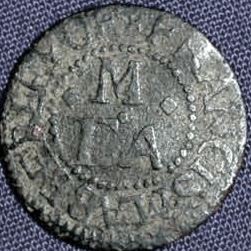
Reverse: varied from images chosen by merchant or the coat of arms of the London Livery Company of whom the merchant was a member. Usually, the merchant’s name was written around the edge.

⇒ The letter ‘J’ was not in common use at this time, and usually “I” was used – hence Iohn for John.
|
REMEMBER: I = J |
OCCUPATION/NOTES |
TOKENS |
|
Robert Frier + Joan (Both died in 1692) |
Oat meale maker Oatmeal was made by grinding ‘shilling’, that is oats from which the husks had been removed, and it was a major element in the diet of poorer families – so small change tokens important. |
Fleur de Lys – a symbol used in the Royal Coat of Arms so used by merchants to suggest quality of product. |
|
John Goddard + Barbara (Died 1663 + 1678) |
Grocer Not an old Farnham family as earliest records are the baptism of John’s 2 children in 1640’s |
Sugar loaf symbol – sugar was sold in cones (see image below). |
|
John Genane + J |
No information – last name probably misspelled |
No image found |
|
John Holloway + Mary (Died 1662 + Mary remarried to another Farnham Tallow Chandler, William Marriner) |
Tallow Chandler One of John’s tokens, dated 1658, was unearthed on Firgrove Hill. Holloway was a large Farnham family – both shop keepers and Wrecclesham Yeoman |
Row of candles to show what he made and sold. |
|
James Hunt (no wife listed on token) Mr James Hunt buried 1678 – ‘Mr’ indicating that he was a ‘gentleman’ |
Linen Draper Benjamin Hunt, son of James, Farnham merchant, apprenticed to Grocers’ Company, London 1687 |
Fleur de Lys/Castle = symbols chosen to be distinctive (Farnham Castle?) |
|
Richard Lunn + Margery (Died 1670 + 1668) |
Draper Shop in The Borough |
Fleur de Lys/Dragon = symbols chosen to be distinctive |
|
Francis Mabberly + Anne (Married Anne Lickford in London at end of apprenticeship; Anne died c. 1660, and Francis in 1688 |
Fishmonger Also inn-keeper of The Bush Inn |
Fishmongers’ Company Arms – completed London apprenticeship |
|
Henry Morris + Elizabeth (1652-1659: 4 children baptised in Farnham; no burial records) |
Fishmonger 1655 – took on Gervase Searle (son of a Farnham yeoman) as an apprentice |
Fishmongers’ Company Arms – completed London apprenticeship |
|
James Wroth/Wrath + Mary (Mr James Wroth buried in1682 + Mary, widow, in 1692) |
Linen Draper Wroth family influential in Farnham for centuries – shop in The Borough, owned The Lion and Lamb etc |
Symbol appears to be a plant with 3 flowers – needs a heraldic expert to interpret! |
|
John Draper + Mercy 1656 Will of John Draper, Wheelmaker of Farnham left all his estate to wife Mercy for life and after her death distributed among their many children. |
Wheelwright Many wheelwrights were also blacksmiths as the successful creation of a wheel demanded the precision of the wheelwright and the specific metal-forming skills of the blacksmith.
|
Blacksmiths’ Company Arms – completed London Apprenticeship so entitled to use their Coat of Arms. |
Conclusion
Farnham may have had other merchants who no doubt issued tokens, but the ones discussed here are those that survive. From time-to-time, Farnham merchant tokens come up for sale with asking prices around £50 depending upon the quality.
Select Sources: Images of the tokens can be seen on Exploring Surrey’s Past website. Wills and parish registers are available on ancestry.com with a subscription. National Archives have records on some of the people mentioned in this post. Google books and images, as well as Coin Dealer catalogues were also accessed.