A collaboration of Sheila Kleiman and Roger White
“In 1803, my father, William Pocock, who was engaged to Fanny Willmer, made the acquaintance of another Willmer sister, Nancy, and it must have been not long after this that she started a school for young ladies at Farnham, that acquired a well-deserved reputation and maintained it for many years. At the end of the first half-year, going home to her parents to spend the holidays, or part of them, with them, she was well pleased to find that she had met all her expenses, and after paying for the post chaise had half-a-crown in her pocket.”
The source of this quotation is In Memoriam by William Willmer Pocock (WWP) – a family memoir written in honour of his father, William Fuller Pocock, who married Fanny Willmer of Petersfield and Farnham. To clarify, the reference to ‘Nancy‘ should be taken as meaning ‘Ann’ who never used her birth name, Nancy.
We have written three posts covering the history of the Willmer Family of Petersfield and Farnham, going back as far as the late 1600’s. Please go back and read them if you haven’t done so ~ such an interesting family! Now we finish off the story with a post on Willmer House in Farnham, the school, and the Willmer sisters! Keep in mind that this is not a history of Willmer House but a survey of its association with the Willmer family.
Background
We are going to start our story in 1805 when we have the first actual record of Miss Willmer living in Farnham. We know that Ann (20) had started her school by this date, seemingly a small venture. Her sisters Fanny (23) and Mary (17) joined her, leaving Harriet (16), Jane (12), and Caroline (8) at home in Petersfield with the Willmer parents. In time, Harriet and Jane also moved to Farnham and lived in Willmer House.
We do have some idea of what the Willmer sisters looked like and even their health: “Harriet, a little body with a curly head—so unlike the tall figures and abundantly flowing locks of the other members of the family—was afflicted with consumption. Jane had suffered from want of care in the rapid growth of her youth, resulting in curvature of the spine. The girls’ mother, Mrs. Fanny Willmer, was a highly attractive and pleasant woman” wrote William Willmer Pocock, (WWP) in his family history.
As far as education goes, we know from our last post (Part Three of the Willmer Family) that the girls’ mother was a force to be reckoned with and she must have insisted that her girls could do more than just read and write, such as learning how to speak French. In addition, Ann and Fanny were fortunate in having George O’Brien Wyndham, Third Earl of Egremont of Petworth House as their patron and as a result, “enjoyed society that gave them a finish far beyond what was usual around” (WWP). Here is a letter written to Fanny (now married) by the Earl: “Petworth Dec. 23, 1809. Madam, I am very much obliged to you for the book … and if anything should bring yourself or Mr. Pocock to this place, I shall be very happy to have the pleasure of your company, I am, Madam, Your most obedient, humble servant, Egremont. Lady Burrell is here and desires to be remembered to you and your sister. To Mrs. Pocock, at Miss Willmer’s, Farnham.” (WWP.
A Compendium of Willmer House Records and Stories
Roger White and I have compiled a collection of all the references to the Willmer sisters and Willmer House we found and we would like to share them with you, in chronological order.
In 1805 and 1806, the Farnham Tax Records show “Miss Whilmer” renting a house from Elizabeth Bradford. Mrs Bradford was the widow of Farnham surgeon, Dr. John Bradford. The tax records do not show the address, so we do not know where in Farnham the Willmer sisters were living and running their school.
Mary and Ann Willmer joined the Independent Dissenting Congregation of Farnham known as the ‘Ebenezer Chapel’, which was in Dogfludd Street, in 1806. Ann Willmer’s future mother-in-law, Mary Newnham, was instrumental in raising the funds to build the Ebenezer Chapel to serve the needs of Farnham residents unhappy with the strict Anglicalism of the Parish Church and its vicar, Dr. Locke (who ran a boys school mentioned below).
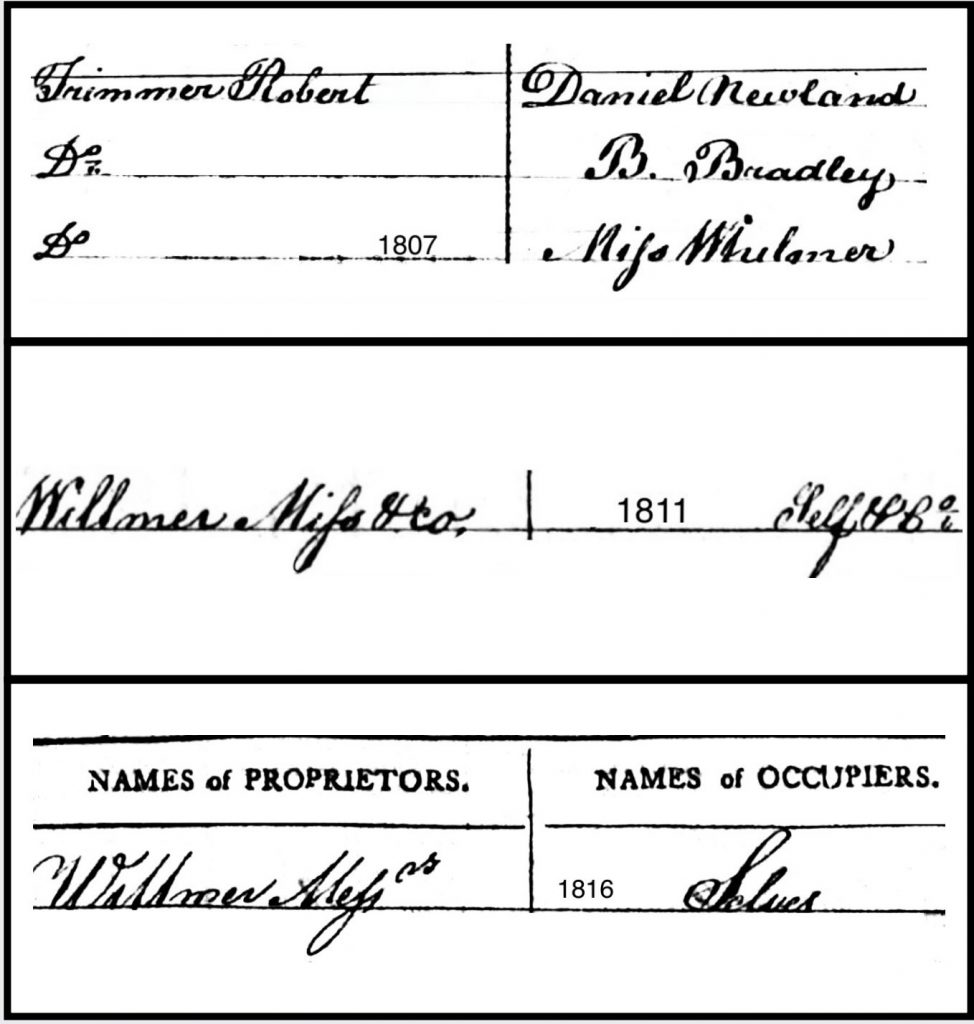
“Miss Whilmer” was recorded in the 1807 Farnham Tax Records as renting a house from Robert Trimmer.
On 30 June 1808, the Farnham Tax Records have three listings for a ‘Miss Willmer’, now spelled correctly: 1) Miss Willmer as a tenant of Robert Trimmer, 2) Miss Willmer as the owner of a property which she was renting out to a brewer, Daniel Newland, and 3) ‘Miss Willmer’ being obliged to pay tax on a personal wealth of £25. Farnham historians agree that Robert Trimmer owned 40 West Street and that Miss Ann Willmer was by then the owner of 38 West Street which she had purchased from Robert Trimmer, but had yet to move in. Although the house and its land were freehold, Pat Heather (a Farnham historian) points out that a small part of the property still belonged to Farnham Manor owned by the Bishops of Winchester and when Miss Ann Wilmer purchased the house from Robert Trimmer, she “became liable for the quit rent of 2s 10d due to the manor”. This was a token fee paid to transfer the property from Robert Trimmer to Ann Willmer.
Where did Miss Ann Willmer, daughter of a Petersfield ironmonger and printer, find the money to purchase one of Farnham most illustrious houses?
“The Earl Egremont had shown himself a friend to the Misses Willmer when he rendered them efficient aid in the acquisition of the house in which they dwelt, one of considerable architectural pretensions and one of the best in the town, The front of this house, nearly 50 feet broad and proportionately lofty, consists of finely gauged red bricks, in which the cornice with madillions and other enrichments are beautifully executed. Towards the end of the 1808, my father took his mother to visit Fanny Willmer at Farnham, being, perhaps, proud to show the house in which she now dwelt, one of considerable architectural pretensions and one of the best in the town.” (WWP)
So however it was funded, Willmer House was indeed purchased and “Ann Willmer and her sisters set up a school, naming it the ‘Willmer House School for Young Ladies’, which catered for girls between the ages 10 and 15 years” wrote Pat Heather.
In 1809, Miss Fanny Willmer, after a nine year courtship, married William Fuller Pocock and moved to Knightsbridge. These were the parents of William Willmer Pocock (WWP) whose family history is much quoted in this post. The couple married in Farnham “as this was her residence” (WWP). Mrs. Fanny Pocock made frequent visits to the Farnham house, often staying for some weeks so clearly the presence of the young lady pupils did not interfere with the family’s life. As her own family grew, Fanny’s visits continued and her son recollected “The internal feature that impressed me most when a boy was a polished oak staircase, which I was not allowed to use with my shoes on“. (WWP) This staircase is still admired by visitors to Farnham Museum today.
In 1809, the school was involved in a bit of a scandal. A London newspaper reported from the Court of Chancery: “A connection between a Chancery Ward, Peter Horrocks (worth £50,000) age 17, and a Miss Clara Jupp (age 15) commenced in 1807 while they were at school in Farnham; the one at Dr Locke’s, and the other at the seminary of Miss Willmer. Guardians of the young man expressed their disapprobation and obtained a Court order restraining all intercourse between the two. But in 1808, Miss Judd returned again to Miss Willmer’s seminary and the intimacy suffered to be carried on with greater warmth”. In 1809, the court ruled that if any further violation of the Court order occurred, Miss Jupp “would be instantaneously imprisoned“. To satisfy your curiosity, in 1811, in Westminster, Peter Horrocks (now of age and free to follow his heart) married Clara Jupp and the couple had at least thirteen children.
The Farnham Tax Records for 1810 reported that ‘Miss Willmer and Co.’ were the owners of Willmer House with the occupiers being ‘ Self and Co.’ Miss Willmer would be Ann, with Fanny, Mary, Harriet, and, perhaps, Jane (now 18). The Willmer household in Petersfield must have been a much quieter place with just young Caroline living with her parents.
The ownership of Willmer House changes in 1812 as Miss Ann Willmer married Dr William Newnham in Farnham. Willmer House would have automatically become the property of Dr. Newnham but the marriage contract must have included the signing over of Willmer House to Ann’s father, Thomas Willmer. He had taken his son, Dr Henry Willmer of London, into the Petersfield business as a silent partner according to Hampshire Archives records. So now the Farnham tax records list ‘Messrs. Willmers‘ as the owners.
The next record comes from an 1812 list of donations to The British and Foreign Bible Society when Miss Willmer gave a guinea; the Young Ladies of her school, Farnham, 10 shillings, and Miss H. Willmer, a 1 guinea.
Sadly, in late 1813, Ann Newnham, after only a year of marriage died, and then in early 1814, her consumptive sister, Harriet Willmer, died, both in Farnham. Willmer House School now largely becomes the domain of Mary Willmer, as no records exist showing Jane as being in charge. Jane Willmer did continue to live in Farnham as when she finally married her long time fiancée, John Constable, in 1832, the ceremony took place in Farnham, that being her residence.
Between 1814 and 1815, the Willmer School received frequent visits from French officers who were prisoners-of-war living on parole in Petworth House, the home of the Earl of Egremont who arranged for them to come into Farnham for French conversation at the school. Apparently, once the war was over following the Battle of Waterloo in 1815, there was no shortage of dashing young British army officers to provide diversion and amusement!
College Gardens, Farnham: The college in the name was a reference to the days when the Senior Department of the Royal Military College moved here in 1814 and left in or about 1835. It was an ideal site for senior military gentlemen, standing opposite Willmer House, for this was also a college — for young ladies. The Misses Willmer, who ran this quite elegant seminary, were under the patronage of Lord Egremont of Petworth. Petworth, while we were still at war with France, used to house many French officers, prisoners of war; and Lord Egremont conceived the humane notion of sending the Misses Willmer a steady supply of such young gentlemen for conversation with their young ladies in the French tongue. Naturally, following Waterloo, ‘this practice must cease’ as they say in military jargon; but was it not providential for the Willmers that Egremont’s friends, the Duke of York, Viscount Palmerston and Earl Mulgrave, then took it into their heads to establish a centre for English officers just opposite their school?
Ashton Booth ‘Historic Farnham – A walk through the old town’ (Farnham Museum Society)
Back in Petersfield, Thomas Willmer, the girls’ father was now in his 60’s and in 1816, he decided it was time to write his will, and he included specific instructions concerning his Farnham house. He named his wife, his son, and daughters Fanny, Mary and Jane as his trustees.
“The Trustees shall permit one or more of my daughters who may at, or after, the time of my decease be desirous to keep school in my Farnham property to do so for a time not exceeding 21 years. Annual rent shall be £55. On the expiration of the 21 years – or at time prior if the school is relinquished – the property to be sold. In this case, the purchase price shall not exceed £1200. In addition, the Trustees may sell the property (if expedient to do so) at any time to a purchaser who places the property in the hands of one of more of my daughters for the purposes of keeping school. In this case, the purchase price shall not exceed £1200.”
Thomas Willmer died in 1818, and Willmer House passed into the hands of the trustees. The Farnham Tax Records, however, showed no change in ownership, continuing to list ‘Messrs. Willmers’ as owner/occupiers. The tax assessors probably found it easier to continue using this label to describe the Willmer Trust that now owned the house. Miss Mary Willmer remained the lady in charge.
The record of donations to The British and Foreign Bible Society in 1823, show that the Young Ladies at Mrs. Abbott’s and Miss Willmer’s School donated £2/2s. The upkeep of Willmer House, with its high land tax, lighting and heating, salaries, food and so on must have been expensive and Mary Willmer took a business partner called Mrs. Ann Abbott. We have found no information about this lady. In 1825, The London Gazette reported that “the partnership was dissolved between M. Willmer and A. Abbott, Farnham, proprietors of an establishment for young ladies”. Willmer House School was back in the sole hands of the Willmers.
Mrs Fanny Pocock wrote to her husband William in 1825 while staying in Petersfield: “If Henry should come down, we hope you will accompany him, and if you come by Farnham ask Mary to let you see Mr. Pain’s side of the garden wall and give your opinion at whose expense it ought to be kept in repair” (WWP). ‘Henry’ was her brother and ‘Mary’ was her sister. ‘Mr. Pain’ was William Pinke Paine, a member of the wealthy Paine family, hop planters of Farnham, and he lived next door to Willmer House in 39 West Street. This garden wall gets a mention in Pat Heather’s book on West Street when William Paine’s daughter-in-law, Caroline Paine (widow of John Manwaring Paine – a key figure in Farnham’s history) became the owner of both Willmer House and 39 West Street in the 1860’s: “The boundary wall between Nos. 38 and 39 was demolished and rebuilt on a new alignment, increasing the size of the upper part of the garden of No. 39“. If you would like more information on the Paine family of Farnham, please refer to Pat Heather’s excellent series of books on Farnham. Caroline Paine, in fact, was the daughter of Dr. William Newnham who had remarried after the death of Ann Willmer Newnham; Farnham was a small town with much intermarriage between leading families.
In 1827, the Farnham Tax Records for Willmer House changes, and the owner/occupier is listed as ‘Miss Willmer‘ rather than ‘Messrs. Willmer’. We have been unable to uncover a reason for this change; possibly, just a different assessor thinking that Miss Mary Willmer was the owner, as she was in charge of the school. The tax records that we can access end in 1831, and ‘Miss Willmer‘ continues to be the listed owner until then.

We have three more records to testify to the Willmers living in Willmer House:
1831: “My father took my mother, whose health was failing, on a 10 day trip to Farnham and Cowes” (WWP). 1832: Caroline Willmer married John Brewer in Petersfield. “After the wedding, Dr. Henry Willmer drove my father, mother, and my sister, Mary Ann Pocock, who had been at the school at Farnham, to Glenridge” (WWP). Glenridge was the Pocock’s country cottage in Virginia Water. 28 September 1832: Mrs Fanny Pocock wrote a letter to her husband from Farnham. This is the final Farnham record in the William Willmer Pocock book.
Now that Caroline was married, Mrs. Fanny Willmer would be left with no daughter at home, so it was time for Mary Willmer to relinquish her job as proprietor of the School for Young Ladies and return to Petersfield, which she did in 1832. No Willmer lived in Willmer House again, although they continued to own it for many years after Mary Willmer left.
Conclusion
The school was leased to a Miss Catherine Greaves and the 1841 census gives us a picture of what the Willmer School for Young Ladies in West Street had been like as the census records that the school was run by two governesses, two teachers, two domestic servants, and had nine pupils. Around 1842, “The house was let to Thomas Hunter who transferred his school, Hunter’s Academy, from Nos. 80 to 82 to No. 38. West Street. The school closed in 1860. The house was purchased in 1865 by the owner of the house to the west, No. 39, Mrs Caroline Paine” wrote Pat Heather. The Willmer trustees still alive in 1865 when Willmer House was sold were Mary Willmer and her brother Dr. Henry Willmer. Mary Willmer never married and lived the rest of her life in Petersfield. The Willmer surname ended with Henry as he was survived by two daughters. Please refer to our post ‘Part Three of the Willmer Family‘ for more biographical information on the Willmer sisters and their brother.
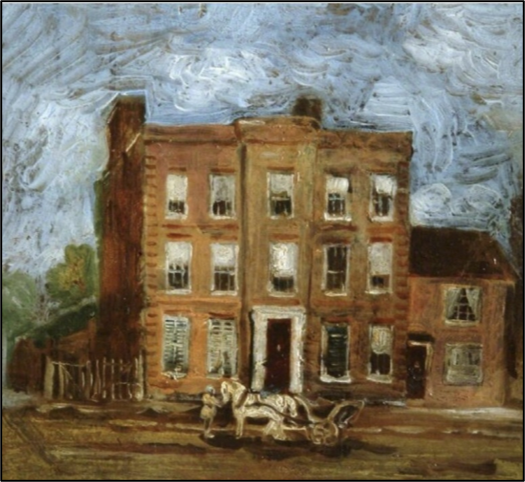
- Roger White, (who has done a lot of research on the Paine family who owned Willmer House after the Willmer family), and myself feel that the following information on the Farnham Museum Web Site that “an Ann Willmer and her daughters bought and ran a school at 38 West Street” should be corrected.
- Miss Ann Willmer died within a year of marriage to Dr. Newnham and had no children.
- We have shown in this post that her sister, Miss Mary Willmer was the person who ran the Willmer School for Young Ladies for the longest period of time.
- Roger and I feel that one of Farnham’s premier buildings and the home of the Farnham Museum no less, deserves a clearer foundation story than the Museum’s web site currently provides.
- We really hope that our research will provide that story.
Select Sources
- In Memoriam – William Fuller Pocock F.R.I.B.A. 1779-1833 by William Willmer Pocock (London 1883). Many thanks to the Paul Mellon Centre of London for providing us with a copy.
- The Town of Farnham: A History of West Street (Volume 3) by Pat Heather (Farnham and District Museum Society 2019). By permission of the author.
- Farnham in History by Roy Waight (Farnham and District Museum Society, 2024). By permission of the author.
- Farnham Buildings and People by Nigel Temple (Phillimore: London, 1973)
- Google Books and Images
- ancestry.com (by subscription)