- Baptised in North Baddesley, Hampshire (near Romsey) in 1719, son of William and Mary Reeves;
- At age 14, sent to Basingstoke to train as an apothecary/surgeon apprentice; William Reeves paid a premium of £82 for his son’s apprenticeship;
- Inherited property in Hursley Parish near Romsey in Hampshire;
- 1741, at age 24, married Mary Mabberly, daughter and sole heiress of William Mabberly of Farnham, Surrey, gentleman;
- 1746 – father-in-law dies, and Edward, by law, then in possession of all the property William Mabberly left to his daughter, Mary Reeves, ‘wife of Edward Reeves, Surgeon of Basingstoke’;
- 6 August 1750: Edward Reeves granted administration of William Mabberly’s Will due to the death of Mary Reeves in February 1750;
- 7 August 1750: Edward Reeves, now sick himself, wrote his own Will;
- 12 September 1750: Edward buried in Farnham Churchyard;
- 7 December 1751: John Mabberly buried in Farnham Churchyard.
Why so many deaths around the 1750’s? Smallpox reached pandemic proportions at this time and the number of deaths exceeded any smallpox outbreak up to that date. Edward Reeves may have been particularly vulnerable as he attended the sick.
The Last Will and Testament of Edward Reeves
In the name of God, Amen. I, Edward Reeves of Basingstoke in the county of Southampton, Gentleman, being sick and weak in body but of sound and perfect mind and memory … do make and publish this my last Will and testament. (Followed by standard religious note hoping for salvation).
In the first place, I direct that all my just debts and funeral expenses be paid by my Executor within three calendar months of my decease.
I give to my most esteemed friend and relative, Thomas Baker of Farnham, gentleman, all my lands in the parish of Hursley in the county of Southampton, now occupied by under tenants, for ever.
All my freehold property in Dogsflood Street in Farnham, late in the possession of my father-in-law, William Mabberly, late of Farnham, deceased, and since his decease in my own occupation, I give to John Mabberly, Victualler of Farnham, surviving brother of my father-in-law, for his natural life.
Upon the death of John Mabberly, I devise the Dogsflood Street property to Edward Mabberly, son of John Mabberly, and his heirs for ever.
All my property in Worldham, Binsted, and Week in the county of Southampton, now in the occupation or tenure of Abraham Smither of Crondall, to John Mabberly for life.
After the death of John, the properties are to go to Thomas Smither, second son of Abraham Smither, and to his heirs for ever. In addition, I give £100 to Thomas Smither at age 21.
I give to Rebecca Sumner, eldest daughter of Mistress Rebecca Sumner, widow of Farnham, the sum of £100.
I give to Jane Smither, spinster, younger daughter of Stephen Smither the Elder of Farnham, gentleman, £50.
I give to Maria Sumner, Jane Smither, and Mary Smither, daughter of Abraham Smither, all linen and wearing apparel of my late wife, Mary Reeves ‘as shall remain undisposed of’.
I direct my executor to distribute £20 worth of bread to the poor of the parishes of Farnham and Basingstoke ‘as he shall adjudge to have the most need’.
All the residue of my estate whatsoever, I leave to my friend and relation, Thomas Baker, for ever, whom I appoint my sole executor.
Dated 7 August 1750.
Administration granted to Thomas Baker on 17 September 1750.
Notes
County of Southampton – think Southamptonshire
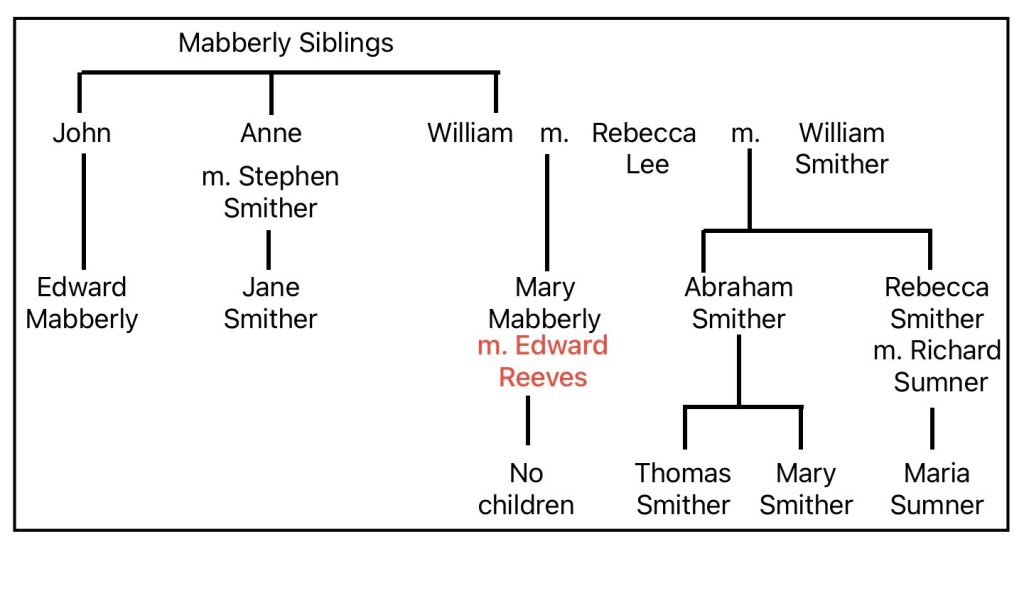
How was the Smither family connected to Edward Reeves? In a couple of ways as Farnham had a lot of Smithers! 1) Mary, his wife, was the daughter of Rebecca Smither, born Lee, and William Mabberly who married Rebecca she was widowed – Abraham Smither, therefore was Mary Reeves’ half brother and Mistress Rebecca Sumner, born Smither, was the step-sister of Edward’s wife, Mary – perhaps Edward and Mary stood as godparents to Maria Sumner, hence why she was favoured; 2) Mary, his wife, was the niece of Stephen Smither and his wife Anne, formerly Mabberly.
As Edward had no children or close relatives to inherit his estate, he returned the Mabberly property that he acquired when he married Mary Mabberly, to that family; he was under no legal obligation to do so. Within a year, John Mabberly died and the property descended to the last Mabberly male standing – Edward Mabberly of Farnham – who was Edward Reeves’ nephew by marriage.
Thomas Baker was an affluent Farnham resident, and was a Justice of the Peace and a Surveyor of the Turnpike Roads. He appears to have been a little tardy in executing Edward Reeves’ Will!
Select Sources: The National Archives; Find My Past (by subscription); Google image.