As those of you who follow me know, ‘Women and their Wills’ is my favourite category of research, so here I am pleased to present the Will of Mary Lintott, born Mary Mabberly, who lived her whole life in Farnham. She was a woman of some wealth having servants, horses and a carriage, and owning the leases of three properties including a hop farm.
Pat Heather, well-known Farnham historian, wrote in her wonderful book Women in Farnham and Its Villages 1200-1900 (published by the Farnham and District Museum Society): “18th century widows usually give to charity when they make their wills”. She discusses some “well-to-do” widows of Farnham who made charitable donations to the needy of Farnham, including Mary Lintott and Henrietta Munday. You will find my post on Henrietta Munday by clicking the button below.
I have discussed the Mabberly family previously; they moved into Farnham in the 1650’s as fishmongers, took over the lease of The Bush Inn, expanded their business to victualling, using the profits to purchase the lease of hop grounds and houses in Farnham, and by the time the name died out in the early 19th century, were considered minor gentry. Mary was the eldest child of John Mabberly, inn-keeper of the Borough, Farnham and Mary, formerly Greentree of Bagshot. Baby Mary was baptized in the font of Farnham Parish Church in 1669 – she would probably have been just a few days old. She was a third generation Mabberly of Farnham.
John Mabberly died in 1688 when Mary was aged 19, so it was left to her mother to arrange a suitable marriage for the eldest child of the family. A bachelor appeared on the scene: Henry Lintott, a master clockmaker, who set up in business in Farnham. Henry came from Horsham in Sussex, and his father, John Lintott, was a publisher and printer. The family could afford to set their sons up in apprenticeships and pay the fees required. Henry was apprenticed to John Aylward, clock and watchmaker of Guildford and his brother, Bernard Lintott, served his apprenticeship with the Stationers’ Company of London and became a well known publisher.
Let’s take a quick look at Henry Lintott
This branch of the Lintott family had lived in Horsham, Sussex for centuries and risen to the rank of Yeoman farmers, and were on their way to be considered gentlemen. After he had finished his apprenticeship, Henry opened up a clock-making business in Farnham and in May 1691, he applied for a marriage licence: “Henry Lintott, age about 24, bachelor, of Farnham, Surrey, was granted a license to marry Mistress Mary Mabberly, of Farnham, aged about 22, with consent of her mother, July 18, 1691″. Note that ‘Mistress’ was a title to denote gentility not marriage status. The couple chose to be married in Greatham, Hampshire. A marriage by licence meant that no banns were needed and an out of town venue was more private.
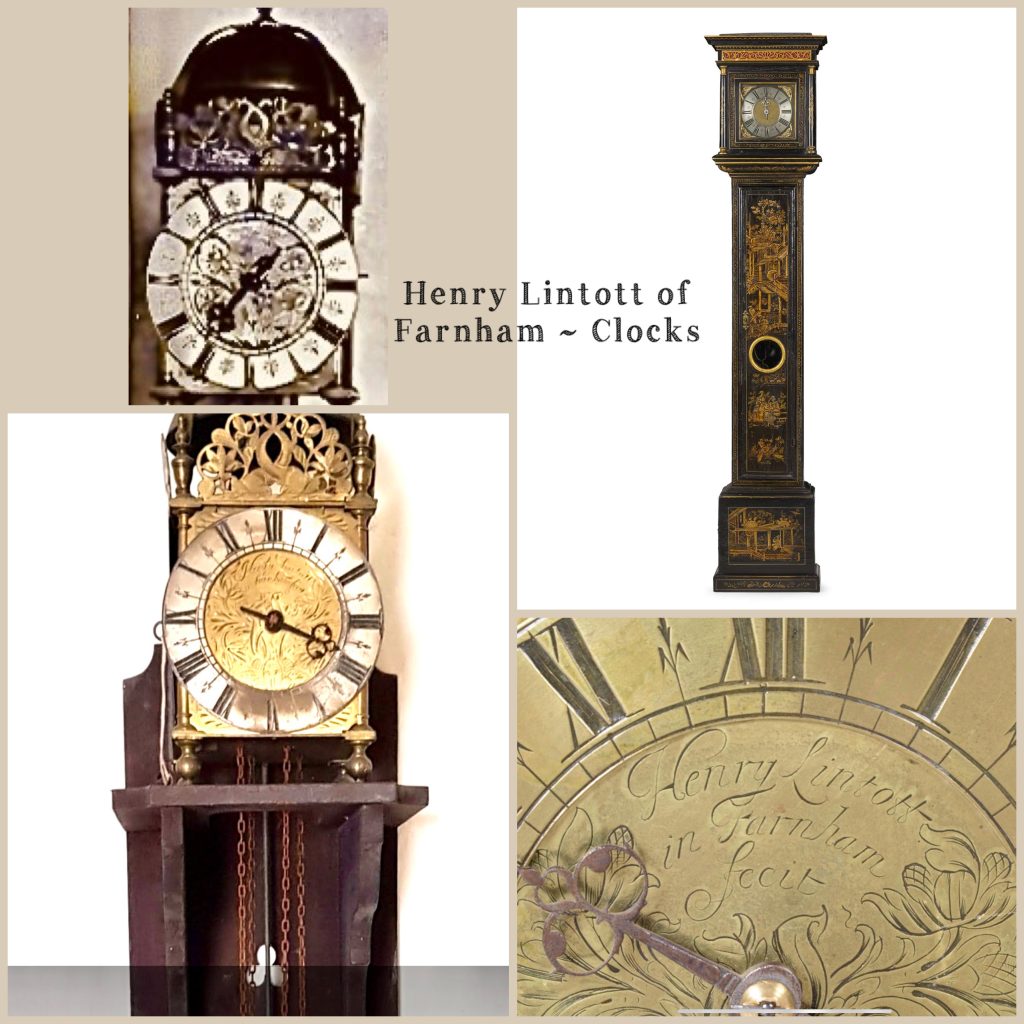
Henry Lintott’s Clocks
The experts seem to agree that only three of Henry’s clocks have survived. As he was only 39 when he died, his output was limited. His best known surviving clock is in the Bermuda Museum and thought to be one of its oldest European artifacts.
John Aylward, Clockmaker of Guildford
Here is a snippet of information about John Aylward, who trained Henry Lintott – there’s always a story within a story! John Aylward built the well known Guildford wall clock that can be seen today on Guildford’s High Street. Aylward was denied permission to set up his workshop in the borough of Guildford because he was not a ‘Guildford man’, so he built the clock outside the borough and proudly donated it to the town. He was given his licence!
And now to the main subject of this post – Mary Lintott
Mary and Henry Lintott did not have any children; Henry died in 1705, and his Will was straight forward – all his estate went to Mary. What happened to his business is unknown. So Mary spent 17 years of widowhood and doing whatever Farnham widows with a comfortable income did. One of the things she did in her later years was to think about her Will as it was very detailed! As Mary was unable to write (she may have been able to read – it wasn’t unusual for women to be able to do one but not the other), she would have needed someone to make jot notes for her and no doubt had many meetings with her ‘attorney at law’, Edward Fisher Junior. She signed the final version with her mark and used her wax seal on 23 May 1722, not long before she died. Her funeral took place 1 June 1722 in Farnham church.
Mary Lintott’s Siblings
| Anne Mabberly – married Stephen Smither and the couple had 9 children alive in 1722 |
| Jane Mabberly – unmarried – Jane’s parents had both made special financial provision in their Wills for Jane as they believed she would never marry (perhaps disabled in some way) |
| John Mabberly – married Mary (last name unknown) and had 6 children |
| William Mabberly – married Rebecca Smither, formerly Lee, and had 3 daughters |
| Edward Mabberly – married 3 times but no surviving children |
Mary Lintott’s Charity
- Mary established a fund for the vicar of Farnham (or some other clergyman approved by the vicar) to receive 20 shillings to preach a sermon on mortality at the end of the regular service every year on September 20th (‘that being my birthday’), for ever.
- Following the sermon, 20 shillings worth of ‘good wheaten bread’ will be distributed to the poor people of Farnham who attend the sermon, for ever.
- On the day after Mary’s funeral, her Executors were to distribute £3 of ‘good wheaten bread amongst the poore people of the towne and parish of Ffarnham’.
- Every year on the anniversary of Mary’s burial, another 20 shillings worth of bread will be distributed to the poor people of Farnham, for ever.
- These tasks were to be carried out by her trustees (brother William and brother-in-law Stephen Smither), and after their deaths, by the Farnham Churchwardens.
- In order to cover the costs of these bequests, Mary directed that the money be deducted from the income of her properties.
How did Mary Lintott dispose of her properties?
Hop Farm in Weybourne: this went to Mary’s nine Smither nephews and nieces, as well as the stock of hop poles, and £100; all to be divided equally. This rather unusual bequest to all Mary’s sister’s children (rather than naming the eldest nephew as heir of this property) probably resulted in the lease of the farm being sold and the proceeds divided amongst the young Smithers. Did this mean that part of the Lintott charity ended through lack of funding?
Snower Hill Property in central Farnham (Snower Hill being the local name for the wide slope at the top of Downing Street): Mary left this to her niece, Jane Smither, who was 18 when her aunt died; this is almost certainly where Mary Lintott lived. Mary had many nieces and was likely godmother to many of them, but I think that Jane Smither was favoured as she would have been of the right age to be a companion / helper to her Aunt Mary. Jane Smither was now under no obligation to marry and she lived a spinster, dying in Farnham in 1758 at age 54.
Hop Farm in Hale: The property including farmhouse, kilns, gardens, orchards, lands (rented out) was left to a designated heir – Mary’s nephew, John Mabberly Junior. He was only a young boy, and Mary specified that the farm was to be held in trust for him and money set aside to pay for him to do an apprenticeship. Mary set out a chain of descendancy involving John’s siblings should John die before having children, which is what happened; the property was likely sold as John had quite a number of siblings alive and well in 1744 when he died unmarried, predeceasing his father.
Items for close family members
Nieces Mary, Anne, and Sarah Mabberly, daughters, of brother William: various silver boxes but these boxes were given to Mary as security for money she had loaned to someone. If the debt be redeemed, then the money received to go to the three girls.
Sister Jane Mabberly, ‘a good suit of mourning and my striped satin gown’, along with various items of clothing, such as a black silk hood.
Sister Anne Smither: my chaise, horses, harness and all things belonging there to; my best suit of clothes, the middle coat belonging to it, my best head clothes, and other clothing items.
Brother John Mabberly Senior, my watch with a tortoise shell case, and to his (unnamed) wife, ‘my quilted gowns and coats’.
Brother William Mabberly, ‘my clock and case, and my silver watch’.
Brother Edward Mabberly, a silver tankard.
Other items owned by this well-to-do Farnham widow were left to numerous people
Silver salver, ladle, large spoon, salts, pepper pot, porringers, small spoons, teaspoons, and tea strainer.
Large brass boiling pots.
Copper pastry pan.
Bedstead and curtains.
Little wooden tables.
Silk gowns.
Cambric handkerchiefs and head cloths.
Gauze scarfs.
Petticoats.
Ruffles.
Diamond Ring.
5lb piece of gold.
Smaller pieces of old gold.
Financial Bequests
Mary Lintott left various amounts of money to various people, including godchildren and quite a number of female friends. The amount needed to fund these bequests was over £500. In addition, she directed her executors to fund the cost of ‘handsome’ mourning clothes for all of her immediate family, including the nephews and nieces, as well as mourning rings for many people.
The Residue
All that Mary owned not specifically allocated was to be divided equally between her brothers and sisters. It is impossible to determine the value of the residue which would have included all remaining ‘goods, chattels, personal goods whatsoever, after my debts paid and funeral expenses discharged’.
Postscript
What happened to the Mabberly Family of Farnham after the death of the eldest, Mary Lintott?
| Anne Mabberly Smither | Died in Farnham in 1728 | Smither family continued in Farnham for many years |
| Jane Mabberly | Died in Farnham in 1734 | Spinster for whom her parents had made special financial provision as they believed she would never marry (perhaps disabled in some way) |
| William Mabberly | Died in Farnham in 1748 | Married well and considered a gentleman; succeeded by one daughter |
| John Mabberly | Died in Farnham in 1751 | The last of the victualler/inn-holder Mabberlys. Succeeded by his son Edward who was a carpenter and father of Ann Mabberly discussed below. |
| Edward Mabberly | Died in London in 1759 | Buried in Edmonton, Middlesex. No surviving children. |
Last Mabberly Record
Ann Mabberly was the great, great granddaughter of the first Mabberly of Farnham, who was Francis Mabberly of The Bush Inn. She was born in 1749 and remained unmarried until her death in 1805; in her Will Ann left her estate worth £100 to one of her nieces. Her burial record in the Farnham Parish Register on 11 March 1805 is the last Mabberly record.
Select Sources
- Pat Heather: Women in Farnham and Its Villages 1200-1900
- ancestry.com (by subscription)
- George Charles Williamson: Guildford in the Olden Times
- Google Books and images