A postscript to the previous four posts on the Willmer family written by guest author, Roger White
“I stumbled upon the Willmers!“
When researching Farnham blood-relatives of mine, namely William Pinke Paine and his son John Manwaring Paine, I realised that the house that the Paines had once owned at 38 West Street Farnham had become Willmer House and, later, Farnham Museum.
However, some of the information on the Museum’s website clashed with what I had found. “In 1809 the house was purchased by Anne Willmer and from this point forwards the building became known as ‘Willmer House’. It was Miss Willmer’s two daughters who set up the school for young ladies” states the website, but we have already explained that Ann (also, confusingly, known as Nancy) had no children and it was her sister, Mary Willmer (1788-1867), who seems the main ‘driver’ of the school.
In a Youtube video (please see the link below), the narrator states that Caroline Paine “Nancy Willmer’s step-daughter purchased Willmer House”. This is a rather odd way of describing Caroline Paine’s relationship to Ann (Nancy) Willmer. Nancy married Farnham surgeon, Dr Newnham, but she died within the first year of marriage. Dr Newnham went on to marry Caroline Atkinson (born in Bolton Percy, Yorkshire), and the couple had a number of children, including Caroline Newnham who married John Manwaring Paine. Surely, Caroline Newnham (later Paine) would have unlikely referred to her father’s long dead first wife as her ‘step-mother’!
After struggling to decipher the Last Will and Testament of Thomas Willmer, the Willmer sisters’ father, I turned to Sheila Kleiman for help, she previously had given me great help with linking my Paines with the Steven’s family of Ash. Sheila picked up the baton on the Willmer family and ran with it, the result being this lucana of history being revealed!
I hope I’ve aided Sheila in some small way to give a more correct version of the Willmer family’s lives and achievements and added a little colour to Willmer House’s story.
Those of you with access to the family history site, Ancestry.co.uk, can find my tree, ‘White and O’Neill Family Tree’, where a more detailed look at the Paines and Newnhams genealogies can be found.’
Roger White — August 2026
It might be interesting to look at these people, so let’s start with Dr and Mrs. Newnham, then their daughter, Caroline Paine, followed by Caroline’s husband, John Manwaring Paine – be prepared to be surprised by these Farnham people!
Dr. William Newnham
William Newnham was born in 1790 to Farnham surgeon John Newnham and his wife Mary Dowden. “He is believed to have been educated at the Farnham grammar school, and, having chosen to follow his father’s profession, he pursued his medical studies at Guy’s Hospital, and also in Paris,” wrote one biographer. According to one of our favourite Farnham historians, Pat Heather, William’s mother Mary Newnham was concerned for the health of poor women which “inspires her son William to specialise in gynaecology and obstetrics in his medical studies. He practices as a doctor in Farnham, and as the author of a great number of medical works, becomes eminent in his profession.” He was one of the early members of what became the British Medical Association and upon retirement from the Association in 1857, a portrait was commissioned (shown below). William was also interested in mental and spiritual matters and published a number of papers on a variety of such topics and was a member of the Royal Society of Literature.
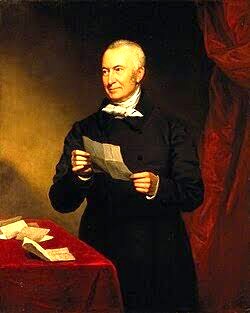
As discussed above, William’s marriage to Ann Willmer was cut short by her sudden death and he remained single for the next seven years. In 1821, he married Caroline Atkinson (discussed below); as Caroline was the daughter of a baronet and the sister of the future Baron de Tabley, Farnham society must have been most interested! William and Caroline had eight children, with six reaching adulthood. William served the Farnham community for forty-five years before retiring to Tunbridge Wells, where he died in 1865. The following is a list taken from an advertisement of the auction held when Dr. and Mrs. Paine gave up their West Street house upon the doctor’s retirement. I think it gives a most interesting window into the life of wealthy members of Farnham society. The auction was held in the Newnham’s home and the advertisement noted that the items “may be viewed the day previous to the sale”. West Street must have been very busy!
- Mahogany four-post, French, and other beds, mahogany and oak wardrobes, chests of drawers, and the usual bedroom appendages
- Fenders and fire irons, hearth rugs
- Brussels and Kidderminster carpets
- Drawing room couch, chairs, and window curtains
- Rosewood chandeliers
- A semi-cottage pianoforte
- Rich ornamental chinaware and about 70 ounces of silver plate
- A pair of bronze equestrian figures on ebony stands
- An eight-day bracket clock in bronzed case
- A set of mahogany dining tables and chairs and a number of sofas and easy chairs
- A set of wainscot bookshelves about 400 volumes of books
- Spanish mahogany writing tables,
- A set of ropes and poles for calisthenic exercises
Caroline Atkinson Newnham
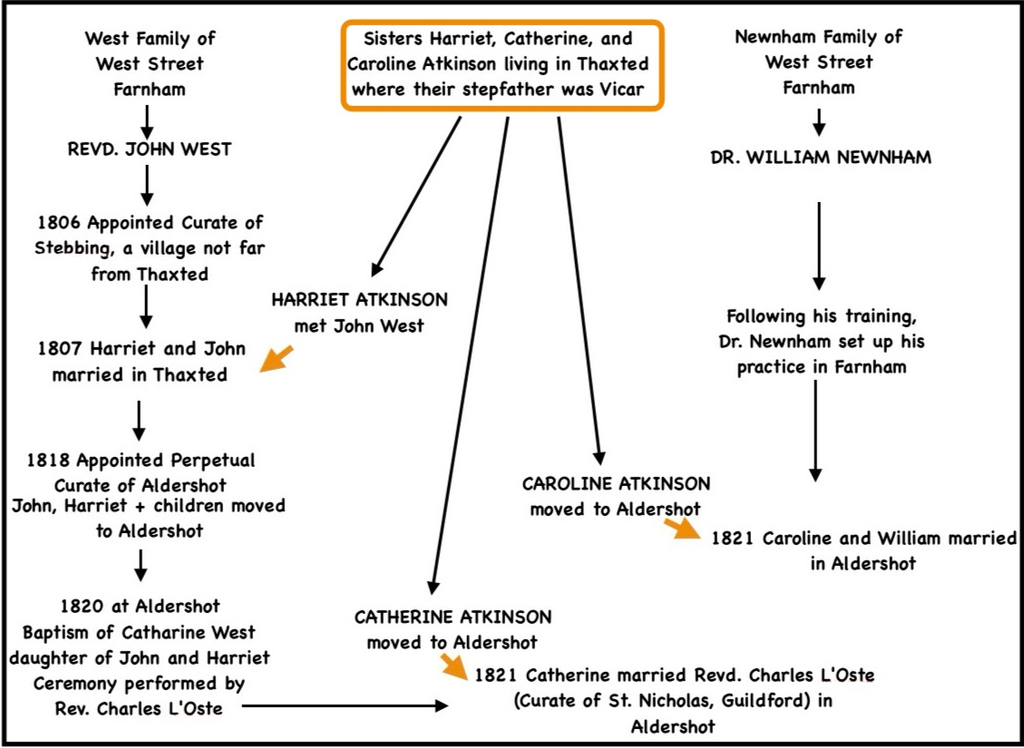
Caroline Atkinson was born in a small Yorkshire village called Bolton Percy, not far from York, where her father was a clergyman, Reverend Christopher Atkinson, who came from a long line of clergyman. Caroline, however, would only have had distant memories of her father, as he died when she was four, and her mother then married Reverend Thomas Jee of Thaxted, Essex. Her mother was born Catherine Leicester and her father was a baronet and her brother was the future Baron de Tabley of Cheshire. Farnham society must have been agog when Dr Newnham brought his new wife back to West Street! Below is a chart showing how Caroline Atkinson came to be Dr. Newnham’s wife.
Catherine Newnham died a couple of years before her husband, aged 71, in Tunbridge Wells.
Caroline Newnham Paine
Caroline was born in Farnham in 1822 and was the eldest child of Farnham surgeon, William Newnham and his second wife, born Caroline Atkinson. Dr Newnham’s marriage to Ann Willmer, cut short by Ann’s sudden death, had not produced any children. The 1841 census shows Caroline and her family and assorted helpers in her father’s practice plus domestic servants, numbering thirteen people in all, living in West Street. Later that year, at age 19, Caroline married affluent Farnham landowner and hop planter, John Manwaring Paine, and the couple had two daughters, Caroline and Alice. Widowed at age 36, Caroline Paine lived on in Farnham at Sandford House in West Street, but by the 1881 census she had moved to what was to be her home for the rest of her life – 179 Cromwell Road, in the London Borough of Kensington. She lived until age 81, dying in 1904, and her funeral at Brompton Cemetery was conducted by the Reverend Henry Portman, her son-in-law. Both of Caroline’s daughters married clergymen.
By an amazing stroke of good fortune, we actually know more about Caroline Paine then is typical and from a very unlikely source – the letters of Elizabeth Barrett Browning (EBB), the writer and wife of poet, Robert Browning. Here is what Mrs. Browning wrote:
1 Apr 1846 – EBB to a friend: “I am going to receive for half an hour a Mrs. Paine who comes from Farnham for that purpose, & has been so affectionate in her letters that I can’t say no to her when she entreats to see me. Living at a distance I shall not be interfered with much – it will be half an hour on Friday .. & there, an end.”
3 April 1846 – EBB to her husband, Robert Browning: “She is a Mrs. Paine who lives at Farnham, & learns Greek, & writes to me such overcoming letters, that at last, & in a moment of imprudent reaction from an ungrateful discourtesy on my part, I agreed to see her if she ever came to London. Upon which, she comes directly – I am taken in my trap – she comes & returns the same day, & all to see me. Well – she had been kind to me: .. & she came at two today … My antagonist was a young, pretty woman .. (rather pretty ..) enthusiastic & provincial, .. with a strong love for poetry & literature generally .. loving Carlyle .. & yourself (could I hold out against that?) & telling me all her domestic happinesses with a frankness which quite appeased me & prevented my being too tired .. though she stayed two hours, & wasn’t you!”
Despite EBB’s cynicism, she appears to have been taken with Caroline and in August 1851, the Brownings visited the Paines’ home in Farnham, where they were introduced to the prominent novelist and social reformer Charles Kingsley.
15 September 1852 – EBB to Caroline: “So sorry I am, so very sorry that you should have been unwell, my dear friend. That’s the worst of it. Now remember it’s the worst, & don’t exert yourself & provoke more evil by thinking of Saturday or Monday, should you not be quite well … We shall be here you, & will bring it when you come, though I am nearly overwhelmed by the multitude of books just now – I write in great haste … With regards, the kindest from both of us, to Mr Paine, & Miss Paine”. (The middle part of the letter has not survived).
31 October 1855 – Robert Browning from Paris to his London publisher about a new collection of his poems called ‘Men and Women’: “Have the goodness to send copies to the following persons … Mrs. Paine, Farnham”. Caroline’s name is one of only seventeen names which included Alfred Tennyson, Dante Rossetti, and John Ruskin!
John Manwaring Paine
John was born in Farnham in 1808, the eldest son of William Pinke Paine and his wife Eliza Manwaring and clearly he set himself to work early in life in partnership with his father. When the Land Commissioners came to Farnham in the 1830’s, they determined that John and his father owned, or leased from others, 942 parcels of land in Farnham Parish which ranged from houses, hop-kilns, hop fields, arable fields, timber plantations, cottages, and one dog kennel! After his father’s death, John was described as the principal hop grower in Farnham, occupying some 600 acres, and needing 2000 pickers in the late summer to harvest the hops.
Using the wealth accrued from his many businesses, John Manwaring Paine built Sandford House (39, West Street) on a parcel of land severed from the grounds of Willmer House and by 1857, the family had moved in. John, however, was not to enjoy his new home for long as in 1858, during a visit to London, John died, aged 51. John Manwaring Paine was buried, with full honours, in Wrecclesham Parish Church, with a memorial window later erected in St Andrew’s Church by the people of Farnham.
Upon his death, one obituary wrote: “John Manwaring Paine, esq, of Farnham: the charitable institutions of Farnham have lost in him a munificent contributor and every good work had his ready support”. Some of the projects John supported:
- He donated the stone to build a church in Wrecclesham from his quarry at Dippenhall (his father gave the land) – St Peter’s was dedicated in 1840;
- He contributed to the restoration fund for St Andrew’s Church, Farnham;
- He donated land for a water tank in Wrecclesham (notoriously short of water at the time) and his father provided the land for a second tank.
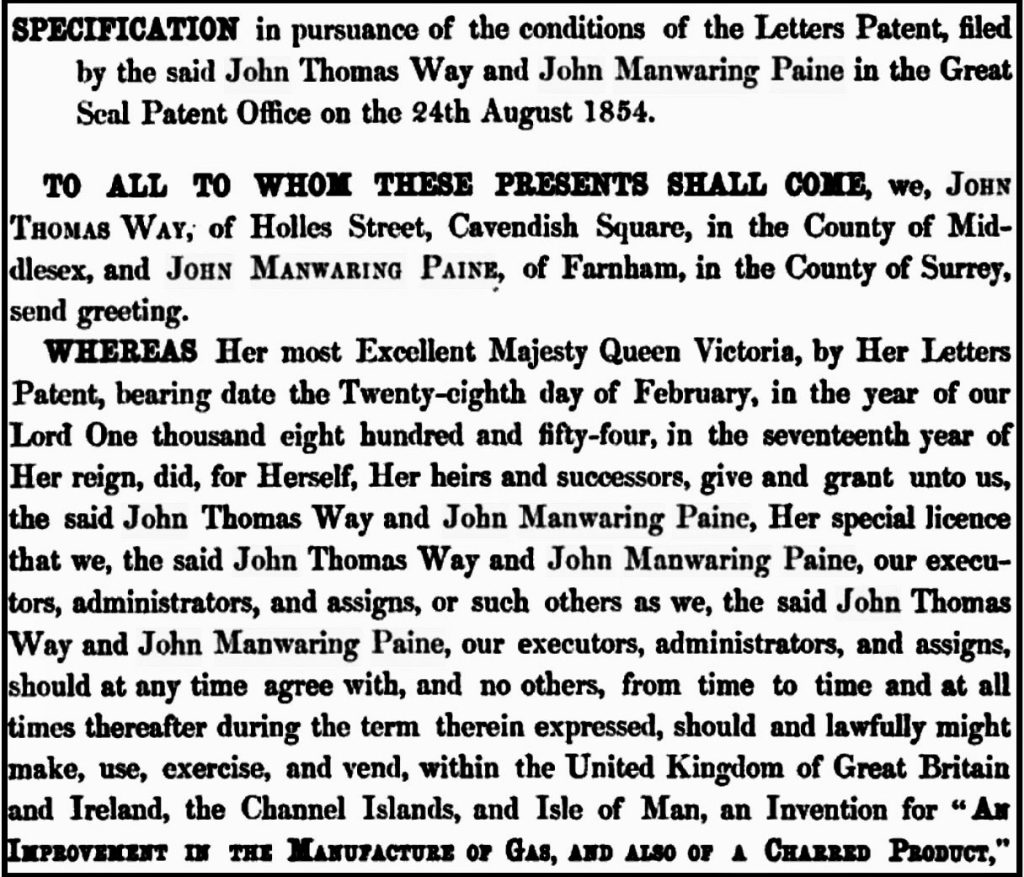
A surprising side to John Manwaring Paine also existed – he was interested in mechanics and being part of the modernising of England’s industry. For example, John and a colleague were applied for a patent for an invention of theirs: “The products of our process are inflammable gases, suitable for giving light and heat, and a charcoal fit for deodorizing, disinfecting, and decolorizing 35 purposes.”