A collaboration of Sheila Kleiman and Roger White
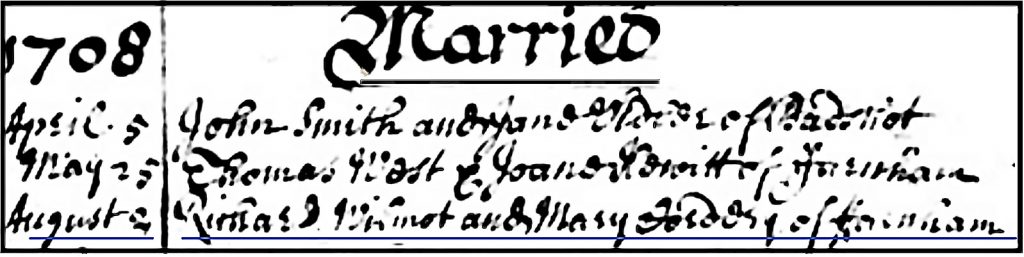
We believe that Richard Willmer was born in Petersfield in 1677, the son of William Willmer and that he moved to Farnham by 1708 when he married Mary Cordery, sister of Nathaniel Cordery, a Farnham schoolmaster. Interestingly, the Vicar of Farnham recorded the marriage and subsequent baptism of Richard and Mary’s five children under the name ‘Wilmot’ for some reason best known to him!
Richard Willmer had gone beyond his family’s traditional trade of woolcombing (disentangling and straightening wool fibres) to actually making the worsted yarn which was used for clothing and especially, gloves and stockings. As other aspects of the English wool industry were in decline, the making of fine worsted was in the ascendancy. In 1736, Richard’s business provided him with the funds to purchase the leases of two side by side properties in Dogfludd Street as well as a hopground. In his own words: ‘the eastmost of my two tenements of the house where I now live along with the eastmost half of the adjoining hopground situated in Dogfludd Street, Farnham’ plus ‘the westmost half’ of the same, which he rented out. Pat Heather (‘a celebrated Farnham historian’) in her book on East Street has sited Richard Willmer’s properties in the area of 84 to 87 East Street (which replaced Dogfludd Street). She also notes that later in life, Richard left the Established Church and became a Nonconformist as were a number of other property owners in the Dogfludd area.
As is often the case, Richard Willmer’s Will is the best source of information on his family so let us focus in on that document which is dated 20 January 1760. Richard died six months later, age 82. He had been predeceased in 1744 by his wife Mary (aged 66 according to the memorial stone on the wall of Farnham church), and also by his son, Richard, which meant he had no surviving wife or son and had to look to his daughter Mary Eyles as his primary heir and executor.
This is the Last Will and Testament of me, Richard Willmer of Farnham in the County of Surrey, Worsted Maker. I do dispose of my Worldly Estate as follows:
- Daughter Mary Eyles, widow, to have for life the eastmost of my two tenements of the house where I now live along with the eastmost half of the adjoining hopground situated in Dogfludd Street, Farnham. After her decease, property to go to her daughter Mary Eyles for ever.
- Granddaughter Mary Eyles £10.
- As long as my daughter Mary Eyles continues my trade of worsted maker, and maintains the properties in good repair, she shall have the use of the western half of my Dogfludd property. A further condition is that Mary is to pay my daughter Jane Burch of Petersfield (wife of Thomas) the yearly sum of 20 shillings.
- At such time that Mary Eyles discontinues the trade of worsted making, or at her decease, the westmost half of the Dogfludd Street property with hopground to go to my daughter Jane Burch for ever.
- Daughter Elizabeth, the Wife of Marmaduke Daintrey of Hartley Row in the County of Southampton, Gentleman, £20.
- Daughter Joane, now the wife of William Turner £20, solely, separately and apart from her husband and he to have nothing to do with same.
- Grandson Thomas Turner, son of Joane, £10 (Marmaduke Daintry to invest the money and use it to the benefit of Thomas who shall receive the capital at age 21).
- Granddaughter, Anne Willmer, £10 (Marmaduke Daintrey to decide when it is the most advantageous to give her the money).
- Grandsons, Richard and Thomas Willmer, £10 each and son-in-law, Thomas Burch, schoolmaster of Petersfield, to use the money for the maintenance and education of the boys.
- Three grandsons, Richard and Thomas Willmer and Thomas Turner to share my woollen and linen wearing apparel.
- Residue, including all my household goods and furniture, stock of worsted and yarn, my money and stock, to daughter Mary Eyles.
- A stone to be erected over my grave the same as the one that is over the grave of my wife.
- Executrix: Mary Eyles. Witnessed by John Geere, Richard Dare, and John Lacey.
- Signed and sealed by Richard Willmer (2 sheets of paper).
- 15 April 1761: Administration granted to daughter, Mary Eyles following her oath upon the holy Evangelists to faithfully administer the will in the presence of her surrogate, John Wigmore (Vicar of Farnham).
Here is an excerpt from a family history published in 1883 by a descendant of Richard Willmer: “From Farnham Church: On the west front of the tower, a small stone is inserted stating ‘Near this place lies interred Mary, wife of John Eyles, daughter of Richard and Mary Willmer. She died Jan. 16, 1779, aged 71 years’. Adjoining this, is a slab of Sussex marble of about the same size and inserted in the wall, but so decayed as to be hardly deciphered. The following, however, can be traced: ‘the wife of [Richard] Willmer, who died the.. day of M…, aged 66 years‘ and also ‘Richard Willmer, who died 1760 aged 82 years’. I suppose they were people of some influence to have their memorials inserted in the structure of the church” (William Willmer Pocock).
A simple family tree would be useful here:
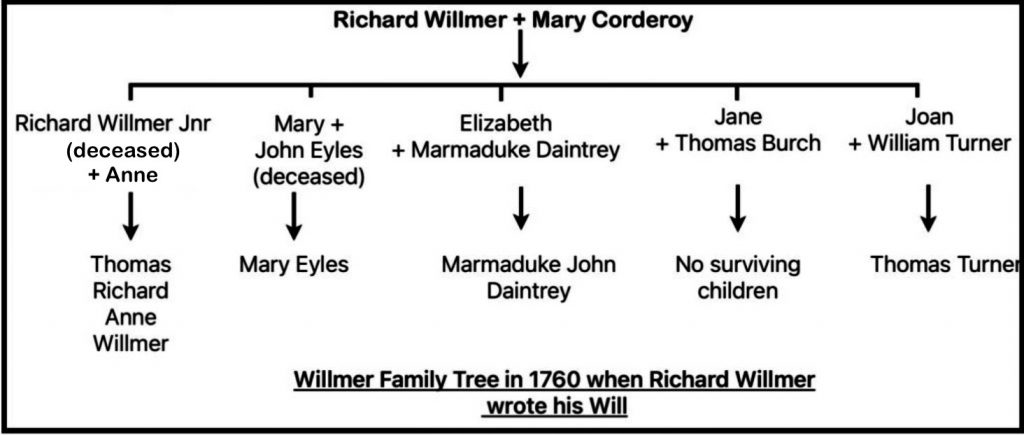
We will look at Richard Willmer Junior in the next post – he predeceased his father.
Richard’s daughter, Mary Willmer married John Eyles (a Cordwainer from Bishop Waltham according to their marriage licence) in Farnham in 1738 and the couple lived in Farnham and had one surviving child – a daughter, also called Mary. Little is known about Mary Eyles (Senior) other than she died a widow in 1779 (age 71) as recorded in the Farnham Parish Register.
Richard’s granddaughter, Mary Eyles (Junior) stayed close to her roots and in 1763 married another woolcomber – William Hawke of Farnham. William’s occupation in a Trade Directory was described as ‘worsted manufacturer, stocking manufacturer textiles, clothing‘. Mary’s inheritance of the eastern half of her grandfather’s Dogflood property would then have become the property of her husband. Mary and William Hawke had eight children including ‘Marmaduke Hawke‘ (known only as a ‘bachelor of Farnham’ when he died at age 37) and the youngest, reflecting the growing trend of middle names, ‘Richard Willmer Hawke‘ (who became a hosiery maker in Tewkesbury). Mary Hawke was buried at Farnham in 1790, sadly recorded only as ‘The Wife of Wm. Hawke‘; she was 49.

Richard’s daughter, Elizabeth Willmer married a London gold and silver smith called Marmaduke Daintrey who specialised in the making of sterling silver spoons, still available from time to time in auction sales today. When Elizabeth’s father made his Will in 1760, the unfortunate couple had lost many children, including a daughter (Elizabeth) and three successive sons, all called Marmaduke. Finally, Marmaduke John Daintrey, was born and survived to inherit his father’s estate, became an attorney, and set himself up as a gentleman of Petworth. By 1760, Elizabeth and Marmaduke had taken a house in Hartley Row, Hampshire and are both buried in Hartley Wintney church. According to a Hartley Wintney history site: ‘In the 1700’s, the coaching route from London to the West allowed various trades to flourish, and housing was built along the coach road and this area became known as Hartley Row.’ As we shall see in the next post on Richard Willmer Junior, the choice of the Hartley Wintney area was not a coincidence, as Marmaduke Daintrey was one the trustees of his brother-in-law’s estate with responsibilities for Richard Junior’s widow and children.
Richard’s daughter, Jane Willmer was married to a Petersfield man, Thomas Burch in 1746, the son of a Petersfield inn keeper. Both Thomas Burch and his brother Henry were Petersfield schoolmasters at one time, but from Thomas Burch’s Will, we know that he derived his income from the cutlery trade, bookbinding, and bookselling. When Jane’s sister, Mary Eyles died, the western half of their father’s property in Farnham passed to Jane, meaning it immediately became part of her husband’s portfolio – no property ownership for a married woman. In terms of family, however, the marriage was marred by tragedy as each of their four children died shortly after birth. Jane outlived her husband so the Farnham property in Dogflood reverted to her and she named her nephew, Thomas Willmer, as her heir.
Richard’s daughter, Joan Willmer married in Holborn, London in 1749, a man called William Turner – we know this as the marriage record says that Joan Willmer came from Farnham. Unfortunately, the name ‘Turner’ was so common in London that further research is impossible, especially as the marriage record did not mention William Turner’s trade. We do know that in 1760, the couple had a son called Thomas according to Richard Willmer’s Will; however, in the 1794 Will of Jane Burch discussed above, another son, Richard Turner, is mentioned but not Thomas.
Grandchildren Thomas, Richard, and Anne Wilmer were all provided for by their grandfather, Richard Willmer, as by 1760, they were fatherless. We will look at these three in the next post.
Here we have set the scene for the next episode of the Willmer story. Over a hundred years before Willmer House in West Street became so named, we have the Willmers well-established in Farnham with an outlier in Petersfield and the Hartley Wintney area.
Select Sources
- London Metropolitan Archives and Guildhall Library Manuscripts Section, Clerkenwell, London, England; Reference Number: DW/PC/5/1761; Will Number: 12
- Farnham and District Museum Society Journal, Vol 13, no 10: The search for the house of Richard Willmer (Pat Heather)
- The Town of Farnham, Volume 2: East Street by Pat Heather (published by the Farnham and District Museum Society
- Google Books
- ancestry.com (by subscription)
- In Memoriam by William Willmer Pocock (privately published, London, 1883) ~ our thanks to the Paul Mellon Centre of London for providing a copy