A collaboration of Sheila Kleiman and Roger White
In Part One, we saw that the Willmer Family originally had no association with Willmer House in West Street, Farnham (the current home of the Farnham Museum) but lived in the Dogfludd area of the town earning a good living from the making of worsted cloth. This was much in demand in the 1700’s as it was used in the making of gloves, stockings, and fine clothes.
We have discussed Richard Willmer the Elder and all his children, except for his son ~ Richard Willmer the Younger ~ who we set aside as it is through his children that we find the link to the Willmer House of today.
Richard Willmer, Woolcomber of Hartley Wintney
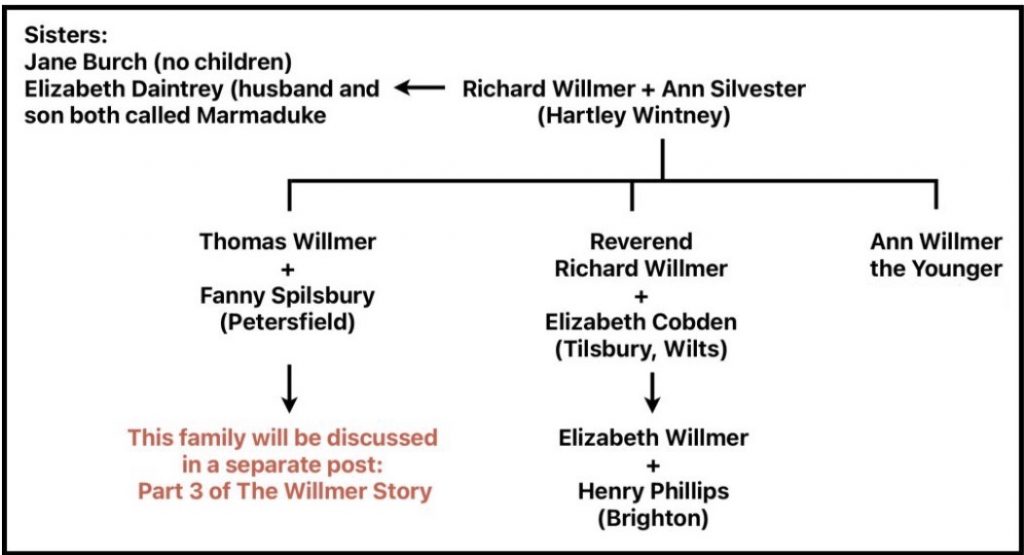
Richard the Younger was born in Farnham in 1719, the first child of Richard and Mary Willmer (formerly Cordery); following in his father’s footsteps, he became a ‘woolcomber’ involved in the making of worsted cloth. In 1744 in Asthall, Oxfordshire, Richard married Ann Silvester, the daughter of Paul Silvester – a tanner from Burford, near Witney. It would be interesting to know how the couple met. By 1745, the Willmer family were living in Hartley Wintney, Hampshire and over the next nine years had five children.
Blackmansbury Quarterly Magazine
We found an interesting source of information about Richard and Ann Willmer in a rather obscure magazine called Blackmansbury Quarterly which focused on English architectural, family, and local history published between 1966 and 1972. The Willmer family were discussed in some detail in Volume 9 which reprinted ‘In Memoriam – William Fuller Pocock F.R.I.B.A.‘ written by his son William Willmer Pocock and originally published in 1883. A granddaughter of Richard and Ann Willmer, Fanny Willmer, married the architect William Fuller Pocock. Excerpts from this book are identified below by (WWP).
Richard Willmer “had carried on a small but respectable trade in wool and had died of consumption resulting from a cold caught at some fair, I think Wey Hill, leaving Richard, Thomas, and Ann, a fourth and posthumous child dying soon after its birth” (WWP).
If Richard Willmer died from ‘consumption’ in 1754 then it is likely that he knew he had the disease as he wrote his Will in 1749. It was a short, generalised document providing for his unnamed children in the event of his death. Here is a summary: Richard Willmer, the Younger, Woolcomber of Hartley Wintney. Trustees: father Richard Willmer of Farnham and Marmaduke Daintrey, brother-in-law to sell his property to provide for his unnamed children. When Richard died in early 1754 in Hartley Wintney, he had three living children, Thomas, Richard, and Ann, and his wife was very close to giving birth. The posthumous child was Paul Willmer (named after his mother’s father) and he was baptised in February 1754 in Hartley Wintney Church; baby Paul must have died sometime thereafter as no future reference to him is made.
What Happens Next?
Our next record comes from the Hampshire Archives dated 27 September 1754: ‘Richard Willmer of Farnham, Surrey, woolcomber and Marmaduke Daintrey, citizen and goldsmith of London, executors of the will of Richard Willmer the younger, woolcomber, deceased, and Ann Willmer, his widow sold a dwelling house in Hartley Wintney, opposite the George Inn to Thomas Cesar of Hartley Wintney, gent.’ So Richard’s trustees liquidated his assets to provide for his children as directed in his Will.
Aunts Elizabeth and Jane rise to the occasion!
Richard Willmer’s sisters, Elizabeth and Jane, both had the means and the space to provide a home for the children. Aunt Elizabeth and her husband Marmaduke Daintrey only had one child and they moved to Hartley Row, presumably to make it easier for Marmaduke to fulfill his role as trustee and nine year old Ann was taken in by the Daintrey family. Richard (7) and Thomas (4) went to Aunt Jane and her husband Thomas Burch in Petersfield who had no surviving children and a prosperous business. Petersfield is now going to become the home of some members of the Willmer family for over one hundred years.
The education of the two Willmer boys was vital so that they could make their way in the world. The next record we have is from 1766 when Thomas Willmer was apprenticed to John Makepeace of Petersfield, Hampshire, a cutler (an artisan who made, repaired and sold knives and other cutting instruments). His brother, Richard Willmer (the third of that name) must have been something of an academic as he was sent to university, almost certainly on a scholarship, perhaps after attending Churcher’s College in Petersfield with whom his Uncle Thomas Burch had connections. Let us deal first with Richard Willmer as he did not have long to live.
Reverend Richard Willmer
- About 1770: Richard Willmer, armed with a B. Litt. degree from either Oxford or Cambridge (record not found) was employed as a school teacher in Midhurst.
- 1772: Appointed Curate of Tisbury, Wiltshire to perform the duties of the aged Vicar of Tisbury.
- 1774: still the Tisbury Curate, Richard was elevated from a deacon to a priest by the Bishop of Salisbury and was now known as Reverend Richard Willmer.
- 1775: Richard married Elizabeth Cobden of Petersfield (daughter of Richard Cobden, a Petersfield draper). Elizabeth came with a considerable dowry of £2,000 which enabled Richard Willmer to purchase the living at Tisbury and he was now Vicar of Tisbury.
- Richard took his new wife back to Tisbury where, in due course, the couple had a daughter, Elizabeth, born in May 1778.
- February 1778: Unfortunately, Reverend Richard Willmer had died in February of that year and was buried in Tisbury. He left a wife and posthumous baby much as his own father had done. As Elizabeth was in mourning, the baby was baptised privately.
Elizabeth Willmer did two things before she left Tisbury – she wisely wrote a will providing for her infant daughter, and then she recommended a certain cleric to the Bishop of Salisbury for the ‘living’ of Tisbury. Yes! Elizabeth Willmer, Widow had inherited the right to chose the Vicar of Tisbury from her husband and would also have received a portion of the tythes. She mentions this in her will and passes on the patronship of Tisbury to her trustees, brother Richard Cobden (Maltster of Midhurst) and brother-in-law Thomas Willmer (Stationer of Petersfield); they, eventually sold the patronship.
Thomas Willmer “brought his brother’s widow up to Petersfield, where he took a house for her, but her property having been injudiciously invested on inferior property at Bristol, Thomas had great trouble in attending to it” (WWP). Disaster struck again as Mrs Elizabeth Willmer died in Petersfield in 1780 so her trustees become the guardians of two-year old Elizabeth. To tie off this story, in 1800, Elizabeth married Henry Phillips, a well-known botanist and landscape gardener of Brighton, had nine children, and lived in Hove near Brighton until she died at age 73. A record exists of Mrs. Phillips setting up an academy for young ladies in Brighton when she was first married; schools and Willmer women is going to be an important connection in the future!
Elizabeth must have received support from her father’s cousin, Marmaduke John Daintrey as she named one of her sons Marmaduke Phillips, and another Daintrey Phillips. The extended Willmer family generally remained close, something we do not always consider in the age before easy communication.
Orphaned at age two, Elizabeth Phillips‘ adult story is not without its own sadness: “Henry Phillip’s grandiose Anthaeum project in Brighton, an elaborate indoor botanical garden topped by supposedly the largest dome in the world, ended in disaster when the structure spectacularly collapsed just before its official opening in 1833. Henry was imprisoned in Horsham Gaol for bankruptcy, and was thus deprived of the means of supporting Mrs. Phillips, and his family, who were dependent on him. Further more, her eldest son, also Henry, committed suicide in 1839. (Wikipedia)
Ann Willmer the Elder and Ann Willmer the Younger
We last saw Mrs Ann Willmer (nee Silvester) widowed at a young age in Hartley Wintney in 1754. In a remarkable turn of events, she “sold off everything and took a situation as wet-nurse in some branch of William Pitt’s family, and finally in the Bishop of Meath’s, in Ireland” (WWP). In later life, we found her in Westminster in 1782, as she left a will. ‘Will of Ann Willmer, Widow of Saint Margaret Westminster: Estate to daughter Ann Willmer the Younger, and son Thomas Willmer. To be buried at the discretion of Executor, daughter Ann Willmer‘. As Ann the Younger was the executor, she possibly was then living with her. She chose to bury her mother in Petersfield where her brother, Thomas, lived. Westminster is not such a strange location when we found that Mrs. Willmer’s nephew, Edmund Silvester, was a prosperous Westminster merchant. The last record we found for Ann the Younger, age 46, was when she received an annuity from her Aunt Jane Willmer Burch of Petersfield, identified as ‘sister of Thomas’ so no last name given. Ann Willmer was described as “marrying below her station, had but little intercourse with the other members of the family” (WWP). The year following her mother’s death, we found a marriage in Westminster of James Allen to Ann Willmer – a possible match to Ann the Younger.
Thomas Willmer of Petersfield
Finally we come to the Willmer who did own Willmer House in Farnham. After inheriting his Uncle Thomas Burch’s Petersfield businesses, he married Fanny Spilsbury. The story of Thomas and Fanny Willmer will be told in Part Three of The Willmer Family.
To help pave the way for the next part of the Willmer story, here is a link to a post about Uncle Thomas and Aunt Jane Burch of Petersfield who were so involved in this story.
Select Sources
- Many thanks to the Paul Mellon Centre of London for providing us with a copy of the Blackmansbury Quarterly Vol 9 so vital to understanding the Willmer story
- Copy of Wills from ancestry.com (by subscription)
- Arts and Humanities Research Council, England
- The Clergy of the Church of England Database 1540-1835
- Hampshire Archives